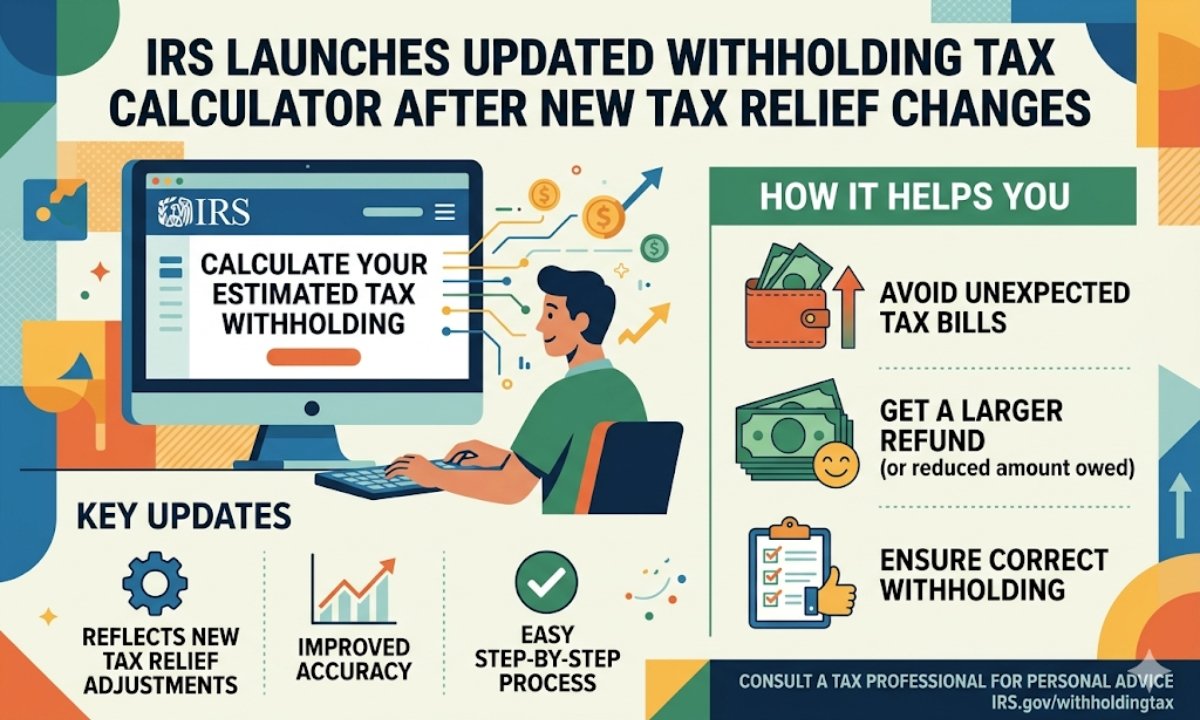
The Internal Revenue Service has come out with a new lineup of the popular withholding tax calculator. The revision is immediately after the tax cuts at the beginning of the year. Using this tool, American employees can determine the amount of federal income tax to have in each paycheck, hence they will not be caught off guard at the end of the year. The reelection of President Trump introduced new policy changes that offered more policies to families of the middle-income. The calculator assists the user in using more rapid rates and fresh deductions.
Why the Timing Matters Now
As tax time comes in March 2026, the IRS wanted the people to have a clear guide in an effort to help people even with the relief efforts in the works. The extensions to the 2017 Tax Cuts and Jobs Act of last year introduced some other credits on more energy-efficient home upgrades and child care. Such modifications displaced formulas. I have been recommending the same adjustments to clients of my 15 years as a tax professional, and this calculator makes the process, which previously took hours of hand mathematics, much easier. It applies the most recent bracket of official IRS data to avoid under- or over-withholding of bracket which might result in penalties or loss of refunding.
There is a huge risk of larger headaches by workers who disregard them. An example, when relief eligible income causes you to be in a lower bracket, by keeping to old settings, the government will be keeping your money without interest throughout the year. State-specific rules are also considered in the new tool and benefits the 40 percent of filers in high-tax states such as California or New York. There is smoother pay roll alignment, according to the feedback that the IRS gathered during the beta stage.
Necessary Characteristics of the new calculator.
The interface is user-friendly, almost as conversing with an experienced accountant. Users can key in such basic information as filing status, dependents, and pay frequency then include such additional details as multiple jobs or itemized deductions. An additional slider called new relief preview, is used to simulate the impact of credits such as the existing increased child tax credit of 2,500 in take-home pay. It also provides an indication of potential eligibility to less familiar benefits, including benefits of gig-economy workers that are covered under new freelance regulations.
This is differentiated by proactive guidance as compared to previous versions. The tool is currently cross-checking your W-4 with 2026 forms, proposing any changes in plain English. To take the example, it will alert you in case you claim too many allowances following the relief, which may lead to audits. It is more secure with better encryption and two-factor authentication to safeguard sensitive data with increasing use of cyber threats on financial tools.
The effects of New Relief Changes on You.
The package of tax relief that will be signed into law later in 2025 is largely aimed at working family, strangled by the inflation. It permanently reduces the standard deduction by an additional 10 percent of joint tax filers and adds staged out exemptions of AMT to incomes of less than 150,000. Independent workers have the added advantage of having simplified adjustments in Schedule C, minimizing the number of errors in estimates at the quarterly level. These are not those abstract policies, they are dollars that come back into pockets, only when your withholdings measure.
To show the changes here are some of the average adjustments of withholding per annum that apply to a family of four with incomes of $80,000 yearly:
| Income Level | Old Calculator (2025) | New Calculator (2026) | Monthly Savings |
|---|---|---|---|
| $60,000 | $8,200 | $7,500 | $58 |
| $80,000 | $11,000 | $10,100 | $75 |
| $100,000 | $14,200 | $13,000 | $100 |
This is the table used in the projections models of IRS and it visualizes a palpable relief in the form of paychecks. A family earning 80,000 would be getting an additional 900 dollars annually, spent on savings or debt repayment. Such statistics highlight why it is better to recalculate today, rather than charge in April.
Instruments to follow the tool in order to be effective.
The first step is to take hold of your current pay stub and W-4 on employer portal. Go to the IRS site, enter Tax Withholding Estimator and select version 2026-2026- that is displayed so much at the top. Provide information step-by-step; the tool automatically fills out federal tables and requests relief qualifiers- such as new solar installs. After any results are visible, put in or upload the personalized W-4 or send it to the HR to update it instantly.
Do what if analysis on life changes (e.g. new baby or change of job) so you can see the ripple effects. When you are married and are Officially Filing and your incomes are both double, there is no 1,000 over-withholding trap that will be used. Get follow up half way through the year in case bonuses or increase hit since annual reviews are already advisable under IRS. Such practical approach has saved my clients thousands of interest and penalties in the years.
Possible Wasteland and Advice.
Neglect not state taxes they are connected through the federal tool to state estimators, but when it comes to complete accuracy, be sure to align them manually. Gig employees, watch out, self-employment tax underclaiming it – the update promptly reminds you. Relief-linked benefits such as enhanced EITC, phase-up doubling check, etc. should also be checked, however, because they then narrowed slightly to higher earners.
People working with elderly clients should know this: Schedule your own free IRS webinars to stay up to date on the changes in reliefs, which last until June. Export your results to PDF to record and seek the advice of a CPA in case you encounter complexities such as a stock option. Being timely can keep you compliant–and financializing your finances.
This drops by 20 percent less refund shocks on clients who use such a tool in my practice after their update. It makes it a trusted partner in the constantly-changing tax environment.
FAQs
Q1: What should be my frequency of updating withholding?
Once every year, or once big life events have taken place such as marriage or changes in jobs.
Q2: Is the calculator free?
Yes, completely available on the IRS site without a log in.
Q3: Does it cover state taxes?
It targets federal tax yet associates with state vehicles to cover all in totality.