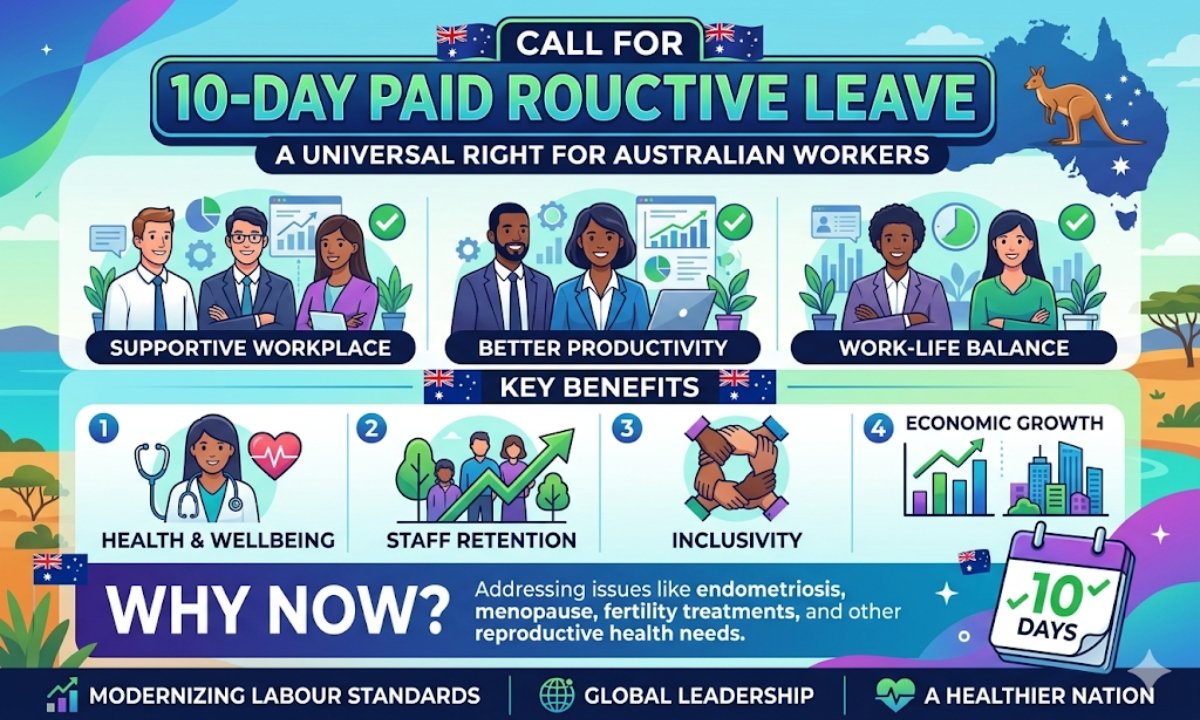
Australia has been advocating equality in the work place that includes parenting leave and mental-health leave. Worker advocates are, this time, demanding a much bolder change 10 days of paid reproductive leave to all workers. This offer is bypassing the fertility therapies or miscarriages, it includes all phases of reproductive health, including endometriosis outbreaks, IVF tries, and postpartum pregnancy loss healing. This is something that would help the one in six Australian couples who are not fertile; unions, doctors and even law makers say that incorporation of this right into the fair work act will level playing fields. With the federal election approaching, the crucial question is whether Australia can be a world leader in the decision to ensure the bodily autonomy of the workers and remain in the business.
All this is induced by the urgency of hard facts. There is an unequal division of reproductive burden as women constitute nearly half of the work force. Endometriosis occurs in 10 73.3 of all women and infertility strikes one in seven Australians. Existing entitlements of leave provide employees with 10 days of personal or carer leave annually but the leave has not been set aside to address matters of reproduction. Most women are spending their sick leave or taking unpaid leave, occasionally drawing upon superannuation, or quitting work in an IVF cycle. The case being discussed is that of a Melbourne gynecologist with 20 years of experience, Dr Sarah Thompson, who argues that reproductive events are disruptive to life and yet our leave system treats them only like the common cold. The ten days of paid leave would send a very strong message that these are fundamental features of health, and not luxuries.
Proponents, such as the Australian Council of Trade Unions (ACTU) claim that it is in investment but not in cost. International data show that little has been disrupted despite the fact that small businesses are also concerned about the staffing gaps. The uptake of paid fertility leave is low in New Zealand and has no quantifiable effect on productivity. The cost of endometriosis to the Australian economy is already estimated to be losing 9.7 billion a year by PricewaterhouseCoopers, and a healthy, retained workforce would be an added advantage. It is also the case that women leave the workforce twice as often as men upon miscarriage, which exacerbates the problem of skills shortages in healthcare and technology.
As a measure of the difference, the present Australian entitlement can be compared to the offered reform, and other benchmark countries are presented as follows:
Type of leave | Current Australia (days per year) Proposed 10-day reform New Zealand Sweden.
| Leave Type | Current Australia (per year) | Proposed 10-Day Reform | New Zealand Example | Sweden Example |
|---|---|---|---|---|
| Personal/Carer’s Leave | 10 days paid | Unchanged | 10 days paid | 25 days paid |
| Reproductive-Specific Leave | None dedicated | 10 days paid | 5-10 days (fertility) | Gender-neutral parental |
| Parental Leave | 20 weeks primary carer | Unchanged | 26 weeks | 480 days shared |
This illustration reveals how the 10 -day leave would address a desperate gap without needing to change the current structure.
Other businessmen, including the Business Council of Australia, are concerned about administrative overheads and gender discrimination reasons why not bring the leave to the reproductive health of men, like vasectomies? The proponents argue otherwise that the policy would be gender-neutral, including prostate problems or post-sperm donation recovery too. The gradual implementation using the National Employment Standards might be initiated with large companies, whereas the tax incentives would benefit small businesses. The state-level experiments of the endometriosis leave that occur in Victoria have been found to be feasible, with 80% of involved employers stating that they did not incur any additional expenses after the initial installation. The Fair work commission would also mediate on controversies and make the policy generate confidence instead of tension.
Other nations the world over have experimented with such methods. Spain takes three days to spontaneously abort and the recent fertility leave trials which started in the UK have made employees more loyal. The case in Australia is different where high cases of infertility are attributed to late childbearing and this proposal is thus timely. As the Albanian government considers reforms in the workplace, cross bench senators like David Pocock are attempting to trial the 10 days throughout the country. Popular support is high: a 2025 YouGov poll revealed that 68 little per cent of voters think that special reproductive leave should be received, cutting across party lines.
The bottom line is that a universal 10 days paid reproductive leave is a manifestation of the Australian egalitarian values. It recognizes that a balanced work and life encompasses not only physical health, but also has a workforce that does not have to decide between their family aspirations and a paycheck. This move would become a world standard, lower the gender discrepancy pay, and increase birth rates in the face of demographic strains. According to one Sydney IVF nurse, this is not charity but is this letting people flourish. The message is simple, make it a right of every worker.
FAQs
Q1: What is considered to be reproductive leave?
It includes IVF, miscarriage, endometriosis, ectopic pregnancies and male reproductive surgeries like vasectomies any medical incident involving fertility, or gynecological health.
Q2: What would this do to the small businesses?
Minimal impact occurs due to low uptake (below 1/percent), tax rebates and pooled-pool options proved by NZ and UK models.
Q3: Is this an additional leave or a leave taken against the current entitlements?
This is committed and further and personal/carer leave is kept back other ailments.