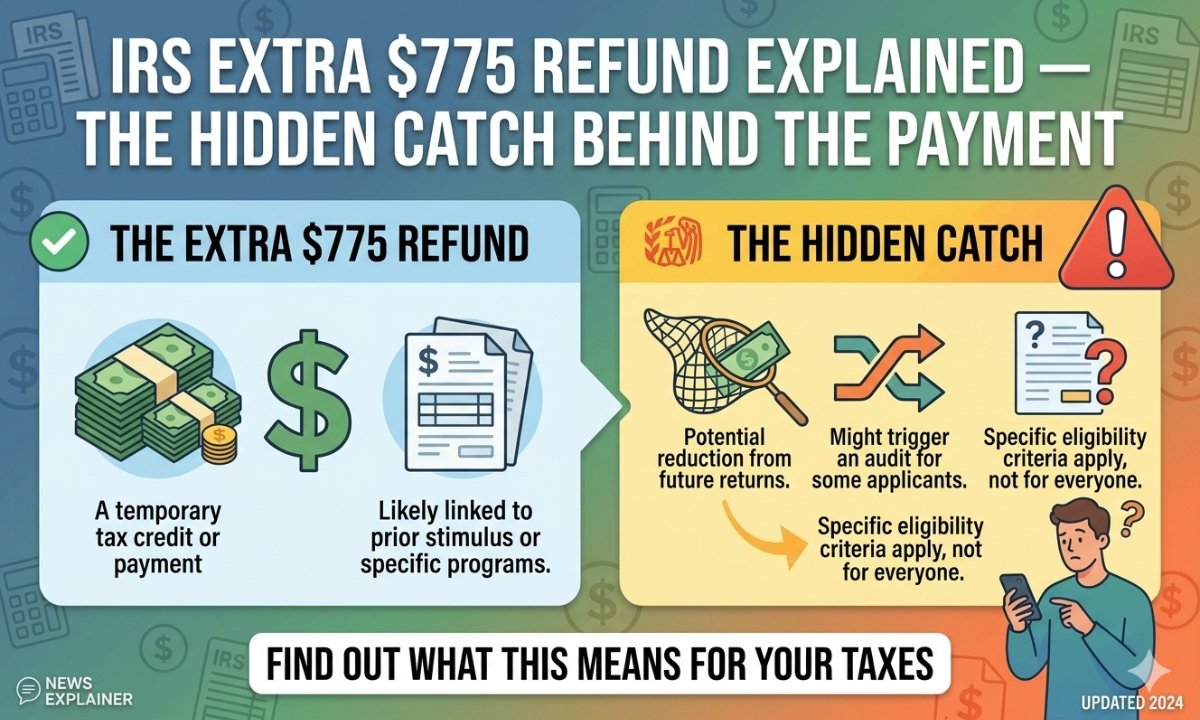
At the beginning of 2026, the Internal Revenue Service started providing millions of people with unexpected notices concerning an extra 775-dollar refund. Much speculation and excitement were raised on the social media and news sources related to this payment, which was associated with modifications to tax filings in 2025. Although it was considered a windfall to many, the IRS referred to it as a rectification of the ignored credits in particular those related to home improvements that were energy-efficient and also increased child tax credits according to new legislation. Nevertheless, a underlying fact might run the celebrations into alarm of those who were not ready.
What Triggered the $775 Payment?
The additional refund was due to the automated review process at the IRS, which reviewed 2025 returns anew after the American Family Security Act legislation was enacted by Congress towards the end of 2025. That Act gave retroactive credit cuts including the residential clean-energy credit, of 50% instead of 30% of qualifying solar panels and heat pumps installed before the end of the year. The among those that filed early missed these updates, thus the IRS made additional payments averaging 775 to over 8 million households by March 2026.
One did not necessarily qualify. This was paid to filers with less than 150,000 adjusted gross incomes who deducted Schedule 1 but failed to take full advantage of the new provisions. However, phases two and three of the child tax credit increased the biggest increment in families having two eligible children as phase-out thresholds were elevated. This was to rescue people in the short run during increasing inflation rates by having data-matching systems filed by large entities within the IRS to confirm eligibility without submitting new files.
Key Eligibility Criteria
To be eligible to get the $775, applicants were to be subjected to strict parameters when they were filing initially.
| Criterion | Details | Estimated Impact |
|---|---|---|
| Income Limit | AGI below $150,000 (single) or $300,000 (joint) | Excludes 25% of filers |
| Qualifying Credit | Energy upgrades or child tax additions claimed | Affects 12 million returns |
| Filing Status | 2025 Form 1040 submitted by Feb 15, 2026 | Early filers prioritized |
| No Prior Refund Adjustment | No amendments filed post-January | Prevents double-dipping |
The table represents how the program was narrowly set to target middle-income households that were most impacted by the cost-of-living increase of 4.2 percent in 2025. IRS cross-referenced utility bills, school records, and previous rebates to substantiate claims and this showed a determination to ensure accurate distribution.
The Omnipresent Déception You Should Be Aware of.
The warning is applied in accepting the $775. It causes a three year window of audit. This additional payment is unlike in a regular refund but it leaves a mark on your account and creates a way of your refund to be reviewed under more rigorous control by the IRS Yield Management System, an artificial intelligence program that identifies inconsistencies with associated deductions. In case your original energy credit application was based on contractor invoices that do not match the IRS records- or the child dependency information does not agree with state records-you may pay showing up full plus a 20% penalty of negligence.
People ignore this since the IRS letter is delivered either through mail or application and it does not have bold alerts making it look like ordinary letters. By 2025, there were 1.2 million such audits, which retrieved up to 2.4 billion, with the majority of the cases involving honest mistakes, such as exaggerated costs of home improvements. The immediate response to this situation by financial advisors is to act on their filings, with the repayment date being only 90 days after deposit. Otherwise, this might lead to liens or wage garnishments, and a beneficial addition might become a loss.
How to Protect Yourself Now
And secure your money fast. To start with, log in your online IRS account to retrieve the explanation of payment and match it with your 2025 return. Collect supporting records, including proof of installation of solar panels/heat pumps between July and December 2025, and confirm the eligibility of the children using birth certificates or the custody papers. When you find irregularities, timely submit Form 1040-X within 30 days to correct in advance, on which case either penalties are usually waived.
Hire a tax expert who will help you make the adjustments after the legislation; several of them will provide an initial audit of these refunds free of charge. The Community tax clinics, which were being expanded following the 2025 reelection plans under President Trump, would offer low-cost services to underserved communities. Follow state tax ramifications as well, since 18 states are following federal amendments and can also make parallel audits. By speaking out, you make a problem a verified profit.
Long-Term Effects to Taxpayers.
This episode of 775 dollars shows and reports about the changing IRS approaches in the age of AI in which there is a combination of kindness and responsibility in bridging a gap of 600 billion a year on taxes. It punishes obedient families and prevents abuse, which is in line with more general fiscal responsibility objectives. Later filings (2026) will contain even more automated corrections where emphasis is put on good record-keeping at the beginning.
In the future, such increases can be attached to electric-vehicle incentives or elder-care expansions, but with more restrictive verification. The greatest beneficiaries of the use of digital tools such as IRS Free File and expense trackers are the taxpayers who make use of them early. This gift though welcome, makes us realize that the relief we receive to-day, requires to-morrow industriousness.
FAQs
Q1: Is the $775 refund taxable?
No, it is a non tax adjustment to previous credits.
Q2: There is the question of what happens if I have used the money.
He or she should pay back in good time or make an installment to escape penalties.
Q3: Can I opt out of the audit risk?
No, the acceptance freezes the review.