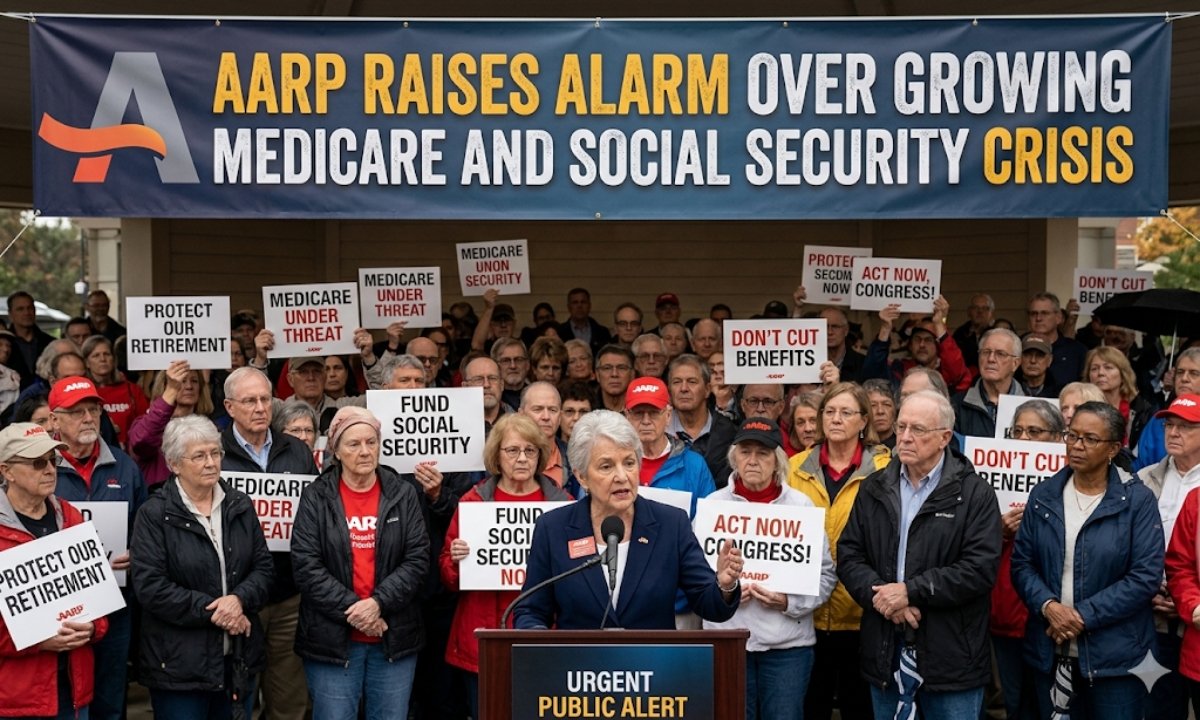
The retirement safety nets in America are tearing and AARP has never raised a loud hallo to capture everybody attention. In a cascading series of emergency reports and press releases issued at the beginning of 2026, the gegenald her eldercare national advocacy group said it was time to note the increasing financial stress on Medicare and Social Security. Due to the full retirement of baby boomers and the nearing eligibility of Gen Xers, according to the forecasts made by trustees, the programs are on a runaway train heading to an insolvent scenario unless congress takes decisive measures. AARP is not only sounding an alarm, but mobilizing millions of its members to demand changes, making it a moral and economic necessity of every family that works.
The Ticking Clock about Social Security.
The foundation of the 67�ányVL million retirees, ill employees and survivors, Social Security is experiencing its greatest shortfall in history. Its Old-Age and Survivors Insurance Trust Fund, as mirrored in the analysis by AARP, will empty in 2034 – in other words, without alterations, benefits will fall to 79 per cent of normal levels. It is not a mathematical exercise but very actual pain to ordinary people. Consider a couple in Ohio stuck in a fixed income, where they would be losing $500 a month and would have to make tough decisions as to whether to go out and buy food or go out and buy drugs. AARP attributes the decades of political obstinacy in which payroll taxes have not kept up with increasing life-span and the decline in the number of workers per retiree. Their call? Increase an upper limit on wage taxation and modify benefits in a gradual manner to protect low earners.
The Ballooning Strain of Medicare.
Hospitalization and doctor visits are additionally included in Medicare, which provides services to 66 9m enrollees, but has an even more gloomy outlook. Its Hospital Insurance Trust Fund is expected to die out by the year 2031, as the cost of chronic illnesses such as diabetes and Alzheimer diseases soar up. AARP Highlights after pandemic healthcare inflation-12% in 2025 alone -which weakens further budgets. The seniors are already paying a lot more out-of-pocket than they paid a decade ago, and unless fixed, the premiums would go up by 20-30%. The collective calls on the widening of the tax base of Medicare and making drugs more price-negotiable, which have been successful, including the 2022 Inflation Reduction Act.
Key Projections at a Glance
To reduce the figures, a summary of the most recent predictions of the trustees compared to ten years ago would help highlight the sense of urgency being brought by AARP:
| Program | Projected Insolvency | Benefits Cut Without Action | 2015 Projection Comparison |
|---|---|---|---|
| Social Security (OASI) | 2034 | 21% reduction | Delayed by 1 year |
| Medicare Part A | 2031 | Up to 11% shortfall | Accelerated by 3 years |
| Combined Shortfall (2035) | N/A | $37 trillion over 75 years | Up 15% from prior decade |
These data are collected based on the official governmental reports of SSA and CMS and show how demographic and healthcare inflation have deteriorated the situation.
Why Now? Policy Paralysis and Demographics.
The mathematical aspects of the crisis that Americans cannot afford are: the ratio of the number of workers to those receiving benefits has decreased already by 5:1 in 1960 to 2.8:1 in 2040, which is 2:1. In an op-ed of February 2026, JoAnn Jenkins of the AARP admitted that failure to act will bring a generational betrayal, and it would strike women, minorities, and rural communities more than the other groups, who are already more reliant on such programs. Both sides promote repackaged versions of the fixes such as raising the payroll tax cap (which is now 168,600), or benefits which are means-tested but partisan politics bogs down any progress. By the year 2027, AARP should break the impasse through its grassroots campaigns that include petitions with more than 2 million signatures.
AARP’s Roadmap Forward
AARP suggests an even-handed operational guide: small increases in payroll-tax on high-income workers, inducements to postponed retirement, and immigration changes to enhance the labor market. They emphasize on bipartisanship by citing successful experiences in history such as the reforms of 1983 of Reagan. Regarding individuals, AARP suggests that they should maximize the IRAs, work more, and have them do their Benefits Checkup service. Though hopeful of legislative windows after the midterms, the group warns that time is running out making the fix smaller every year by 10-15 per cent.
Insuring Your Future despite the Red flags.
This is not doomsday, but it is the alarm bell to protect the constructed generations. The influence of AARP means that 38m members debate the issues of equitable solutions in retirement, as their advocacy ensures that the voices of members are heard to defend human dignity during retirement years.
FAQs
Q1: What happens to cause the Social Security shortage?
What is there are fewer workers maintaining more retirees and there is no growth in income high payroll tax.
Q2Have you been able to manage the cost of Medicare?
Yes–in negotiations over drug prices and expansions of preventive care as AARP proclaims.
Q3: What should I do personally?
Retaliate heavily in 401(k)s, defer benefits, and test free planning facilities of AARP.